15% off Garden Design Software in June!

JUST OVER 3 MONTHS SINCE LAUNCH!

At just over 3 months old, our Garden Design Software package now has over 250 clients and is growing fast. Development continues with more patio components, block pavers, terracotta tiles, granite setts, walling and more added - and our 'Design Your Own Garden' guide has proved popular, alongside the ability to order your plants online, for home delivery.

We have lots more garden and plant components under construction now, as we continue to build on the existing 360+ components...

WHAT IS 'GARDEN DESIGN PRO'?

A simple solution to suit all skill levels and budgets, giving you the tools to create garden designs in 3D - based around Google's SketchUp software. It's easy to learn, quick to use and low cost - starting at just £16.15+VAT in June!

  • Solution based on the Google SketchUp (as used by designers and landscapers worldwide)
  • 360+ (and growing) components and plants to 'Drag-and-Drop' and create designs in minutes, not hours!
  • 36 'Ready-made' borders to suit your style and conditions - buy plants online for home delivery
  • Perfect for beginners, homeowners, students, garden designers and landscapers - try out our FREE sample package to see how powerful it is!

***JUNE SPECIAL OFFER - 15% DISCOUNT OFF MEMBERSHIP***

Summer holidays are on the way, so June is the perfect time to get planning with Garden Design Pro. Use the code gdpro15 in the checkout for 15% off membership, if you join before the end of June. Click Here to take a look...

CAN YOU DESIGN YOUR OWN GARDEN?

Many homeowners want to produce a design for themselves, so to help we've released an exclusive guide to designing your own garden, written by leading designer, author and TV presenter David Stevens.

A 25-page 'e-book' covering the major aspects of creating a design. All 'Garden Design Pro' software members can download it FREE. Click Here to take a look...

ORDER YOUR PLANTS ONLINE, FOR HOME DELIVERY!

All plants in our software (including the 36 'Ready-made' borders) are available to buy online for home delivery, making it easy to create professionally designed borders.

Each plant in our component catalogue has a link through to the Crocus website where you can buy online. All 'ready-made' garden borders have a 2D PDF planting plan and planting list, which also links through to Crocus. Click Here to take a look...

Garden Design Pro software updated with new Walling components for Google's SketchUp!

We've just updated our Garden Design Pro software again, this time adding the first of a whole new range of Walling components for use with Google's SketchUp program.


The first additions (located within the 'GE Edging' category) include a rustic slate style, old fashioned brick walling, traditional stone and a contemporary granite effect wall. Our software members can download them now HERE (you need to be logged-in to access the Zip file downloads).

We have plenty more ready for release soon, before we begin work on more planting components...

If you want to know more about our unique, lo-cost and professional quality software to design your own garden - CLICK HERE for more...

New SketchUp walling components in development

We are currently working on a range of new SketchUp walling components for our Garden Design Pro software, which should be ready for members to download in the next week or so, including dry-stone wall effects, modern contemporary walls, natural pitched stone walling and traditional brick.

For more details on what's already available to download to create your own 3D garden design - CLICK HERE...

The Garden Network gets a new owner

After just over a year, it's time to hand The Garden Network to someone new, as I'm expecting another child, so will soon be looking after '2 under 20 months' very soon! So with my hands full running Toddington Manor's gardens, our courses and tours, plus Applegate Gardens and Garden Design Pro - something has to give! As of the 27th of March, Tim Matcham of Tim Matcham Garden Design, Wiltshire will be running the TGN website.

TGN has been great fun to get off the ground, the first and easily largest of its kind - unique in the professional way its members have participated and contributed, including the established trade associations. I was happy to hand the site over to Tim, because he intends to continue in its original guise of a FREE website, helping small businesses and homeowners to meet, network and improve gardens.

TGN has grown very quickly in the last 12 months with a peak of over 100 new members signing up in just one day from approx 1,000 unique visitors, and nearly 8,000 members in total. It really shows whats possible by organic growth on the internet, without advertising, any PR, 'dirty-tricks' campaigns or traditional press coverage - just an original concept, professionally managed and exposed to a large online audience. Long may it continue!

I've met some interesting members in the last year, doing some great work - which has been very enjoyable, we are lucky to have some great people in this industry. There are however, still some quite outdated opinions around and we did get some hostility from some of the associations initially (understandably I guess), but once the site proved itself to be professional, it was good to see evryone participate. We have certainly influenced the future shape of this industry online, which is set to change dramatically over the coming 12 months...

Good luck to Tim and all the best with TGN, hopefully everyone will make you feel welcome!

Free e-book for software members

All our Garden Design Pro software members can now download the FREE e-book by leading garden designer, author and TV presenter David Stevens.

This 25-page 'e-book' is packed full of real-world advice on creating a wonderful new outdoor room for yourself. This detailed tutorial covers use of space, dealing with plot shapes, planting design, construction techniques, materials and more - to take a look CLICK HERE...

Garden Design Pro's 100th client!

8 weeks has flown by since launching Garden Design Pro and we have just welcomed our 100th client! We are continuing with development of the software, and have more SketchUp components due for release next week.

We are also in the process of migrating our 'Latest News' area's to one central, easily managed Blog - so you can keep up to date with all our news and developments with the software, ready-made garden designs, border planting plans, free downloads and more.

Gardening forum The Garden Network TGN is a huge success since its launch in March 2008

Just a quick post to tell you all where I've been for the last few months! Along with all the fun and games my 11 month old boy brings - my new gardening forum has been keeping me busy, alongside garden design work and Toddington Manor- its all go!

I've been running my own bespoke garden design and landscaping business (in addition to Toddington Manor) for the last 10 years or so, and since teaming up with Homebase to provide their homebase garden design service in 2006, it became apparent to me the sheer demand for inspiration from homeowners.

I was inundated with requests for design and landscaping from across the UK, with homeowners saying they 'did not trust business websites' and 'can I recommend anyone locally?' - so I set about creating a 'level playing field' for the industry and a focal-point for consumers to decide who's best for them, by making direct comparisons on gardening businesses.

Seeing the explosion of Social Networks and listening to homeowners, it seemed obvious to use this technology to help them find local businesses and make informed decisions on who to employ. Since its March 2008 launch - designers are meeting local landscapers, homeowners are commissioning projects, students are meeting the industry, amateurs are helping beginners and businesses are forming valuable new connections, it's very refreshing to see!

8 months after starting 'The Garden Network' which very soon has become know as TGN to its members) Im still surprised at the up take - over 3,200 members have joined so far!

A clever search database structure, means you can find and talk to any type of member to further your business or your own garden and was described as "...a networking website that looks set to become the 'Facebook' of the Horticulture world." by Horticulture Week. It's not restricted to the trade, as members showcasing their work has proved a big draw to homeowners looking for reputable companies, with many winning several commissions in the first few weeks of the site going live.

I didn't want to create another faceless 'Quote Database', as industry professionals know how big a part trust, communication and examples of previous work play in securing commissions. Our poll to Homeowners on TGN (on what they rated as the most important factor when choosing contractors) confirmed this - 53% (overwhelming majority) said 'examples of previous work' was their 1st priority. It's just too big a decision for Homeowners to make by 'filing out a form' - hence the 1000's of portfolios, blogs, comments and messages on TGN.

It's still very new, and we have lots of fresh features, areas, software, downloads and other initiatives under development in time for 2009 which we know our amateur gardeners, homeowners and the trade will reccommend it. Unlike many forum and networking sites out there, it's not meant to be a soapbox for one individual or company, but a tool for the whole industry and interested public to use - you can really lose yourself in there for hours!

If you want to see it, start your own Gardening Blog, meet like-minded gardeners, amateurs, designers, students or professionals - click here to visit the TGN Gardening Forum.

Summer Gardening Course

Last week we held our Summer Gardening Course for beginners, and was fully booked. 12 people attended, which give ample time to dedicate to their questions and show them hands on techniques.
This course covered Summer pruning, and we went into the garden to have a hands on session on our tree paeony, paeonia delavayi var. lutea and viburnum farrerii.


Hopefully everyone enjoyed the day, and all the feedback was positive. The sun even came out so we carried out the nodal and inter nodal cuttings on the lawn in the dappled shade of the copper beech tree, which was really quite pleasant.


On every course, a home cooked lunch is provided by Lady Bowman-Shaw in the Manor house, a treat for the gardeners too! Thanks to all the attendees for their great feedback and also to Julie and Ann the TM gardeners who helped on the day.

The Regal Crown Imperial (Fritillaria imperialis)

I think one of the more unusual bulbs we have in the spring garden is the regal Crown Imperial. Its flowers are bold, bright, and indeed very stately. Standing tall at about 3 feet high, the colours stand out from the rest of the emerging leaves and bulbs in the borders, and if they are near a path the pretty flowers can be inspected at close quarters.


Each petal has a large droplet of nectar hanging from its base, and if you are brave enough, dip a finger in and taste it - it is incredibly sweet. Which got us gardeners wondering - what kind of flying animal/insect would pollinate the frittilaria imperialis? After a little while on google, the incredible answer was revealed....

A botanist working in Cambridge has shown that a European flower is pollinated by a bird. The flower, the crown imperial fritillary, Fritillaria imperialis, which is common in European gardens, is pollinated by the bluetit. You can read the full article here


Drawbacks of the crown imperial? this would be the pungent smell, which occurs when the plant is touched, or even when the strong spring sunlight heats the leaves - not sure how I would describe it, but I have heard it likened to the smell of foxes, but not sure what thats like either....!

When is a bulb not a bulb?

Looking at all the tiny specks of green starting to push out of the ground, one of the first signs spring is definately on the way again, but when is a bulb not a bulb? Ohh the conversations gardeners have!?

You may think that if a plant has an underground storage organ, that remains there year after year, pushing through the soil to flower such as lilies, crocus, cyclamen, erythronium, iris, daffodils lily of the valley and dahlias, then it must be a bulb.


But you would be wrong! Although some of these are true bulbs, the internal structures are quite different – if you look at where the buds and roots originate, and cut them in half you can see how they are all really either adapted stems or roots. We looked them up in a book to make sure - its a long time since I was at college...

· Bulbs – Modified stems, where the overlapping leaves have been adapted to swell and store food and nutrients for the plant eg. Lilies & Daffodils
· Corms –Stubby modified stems, which are vertically orientated eg. Crocus & Erythonium


· Tubers - Short, thickened regions of stem or root, which are used to store food for later growth eg. Cyclamen (stem) & Dahlia (root)
· Rhizomes - Modified plant stems that grow near the soil surface and producing the upward shoot and downward root system eg. iris and lily of the valley.

Plants often modify themselves to ensure survival, and all these modifications occur to survive the British climate - when temperatures drop below freezing, the plant does not have to produce food using photosynthesis – it has plenty stored already for the next year.

Climbers for winter interest

Walls and fences can sometimes be overlooked in the garden, and are incredibly useful for supporting climbers and trained shrubs. These add an extra dimension to your garden – a horizontal one! As plants with winter interest need selecting carefully, I have listed a selection of plants which provide either flowers, berries, or evergreen leaves during November to January.

An evergreen Clematis which flowers in the winter is Clematis cirrhosa. There are a few varieties to choose from, the flowers are pale cream, sometimes spotted red, and hang delicately like small bells. Another evergreen is Clematis armandii, with large leathery leaves but this doesn’t flower until spring.


Cheerful yellow flowers can be found on bare branches during late winter covering a couple of wall trained shrubs. Forsythia suspensa has bright yellow blooms, while the delicate looking pale yellow flowers of Chimonanthus praecox are strongly scented. Popular Jasminium nudiflorum, the Winter Jasmine is a tough shrub and easy to grow.

Berries will provide winter colour along with food for the birds, and evergreen Pyracantha’s can easily be trained along fences and walls. They will flower and fruit well even in positions which receive little sun, and varieties are available with orange, yellow or red berries. Cotoneaster horizontalis can also be used to similar effect with bright red berries.


Evergreen Ivys (Hedera) can be used as a backdrop with summer flowering climbers twining through them, as can Garrya elliptica, the Silk Tassel Bush with its dangling catkins throughout winter. Normally seen as a shrub, Lonicera x purpusii ‘Winter Beauty’ can be wall trained, and is worth seeking out for its sweetly scented white flowers.

A Wedding at the Manor

One of the big events of last year was my wedding to Pat, after no less than 17 years of living together - we thought it was about time!

We had a lovely informal ceremony in May at the neighbouring Flitwick Manor, and all guests then travelled to Toddington Manor gardens to have the obligatory glass of champagne and accompanying photos.

All the gardeners had been busy making it look spick and span the previous week, and the alliums which line the herbaceous borders looked at their best. I was lucky enough to be able to create my bouquet from the flowers and foliage in the gardens (my previous job ages ago was in a florists, so the experience came in handy!) and the flowers for the tables also were from the gardens.
It was a small wedding party, so then back to Flitwick Manor for the feast and speeches, and the day was rounded off by a barbeque in the back garden. We had watched the weather all week, crossing fingers and toes, and as luck would have it, we managed to get married on one of the few sunny days last summer, and it even had the decency for one small rain shower just as we were eating, so didn't disrupt the day at all.


The Manors owners we even on hand to help serve the champagne to our guests from the conservatory, and I managed to pose for one photo with a fork, and one on the 3 wheeler garden truck too! We both had a great day, and it was made special by spending time in the gardens with everyone, along with the individual bouquet and finished with friends, family and all the staff enjoying the evening at home.

New Years resolution!

I'm Back!! My New years resolution is to keep up with the blog posts this year!
I hinted that last year was very busy through one thing and another, so I shall be posting whats currently going on throughout the year, and filling you in on last years developments too.

I hope this damp and horrible weather that seems to stick around for ages will dissappear soon, and we can all look forward to springtime. The birds have started singing in earnest already, looking for mates, which is always nice to hear this side of christmas. The first signs of growth are appearing too, it always seems too early each year, but look closely and buds are swelling in readiness.

We have had a few changes in staff recently, I shall fill you in with the details in another post, but Julie, the new gardener has started working part-time and three weeks into the job is getting stuck in, clearing the borders.


Damp January Borders

This January has been damp again, like the last few months, and not the best condition to garden in day in day out, but work must carry on as otherwise spring will be upon us and the beds and borders will not be cleared, shrubs and roses pruned, and sheds tidied.


The herbaceous borders are now cleared, and forked over, in readiness for their mulch which we shall put on during march. This is a process which we carry out on all the beds during winter.
First, all the old and dying foliage is removed to the ground, using secateurs or shears depending on the type of plant. This gets put into our petrol driven 3-wheeler truck (which was incidentally a birthday present to Lady Bowman-Shaw many years ago from her husband - and is still going strong!) to be taken away - much more efficient than barrows given the amount of material we remove.

Then we carefully rake over the soil to remove leaves which have collected during autumn, paying careful attention to the base of shrubs and grasses so no hiding places for bugs, slugs and disease remain.

Lastly, the whole bed is 'forked over' which is carried out using the smaller ladies fork or border fork, and lightly aerate the top 3-4 inches of soil - this incorporates the remaining mulch from last year, and exposes any pests and/or their eggs.

I like to make sure that any dips and bumps are removed from the beds at the same time by gently sweeping the fork from side to side after forking over, this gives that professional finish and also breaks down any large clods of earth left - then we stand and admire for a little while - before the bunnies, pheasants and leaves blowing about in the wind start to mess it up again! We will tidy them up quickly before the mulch gets put on though, so nothing is buried underneath.

Updates for The Garden - 2007


You may have noticed that my updates for the garden in 2007 have been a bit thin on the ground!


Apologies for this, but this year has been very busy for various reasons, such as a range of new garden courses, getting married, a very dry spring then a very wet and dismal summer, flooding in the garden, many weeds and the lawns continuously growing, as the garden has 'enjoyed' damp and warm conditions most of the year.


I will update you with what has been happening with new posts, looking back at the year to date.

Snow in January's garden

This month we had our first snowfall in Toddington. It had been exceptionally mild and wet before this, but unexpectedly one morning, we woke up to a crisp white blanket covering everything. Gardens always look so neat and clean under the snow, and there is little gardeners can do outside, but it is always worth checking no branches have snapped under the weight of the snow, and theres always the job of keeping the driveway and paths snow free!


This photo show the woods behind the Manor, the main lawn in front of the house and the wonderful mature trees like the walnuts, ceder of lebanon, wellingtonias, silver lime and copper beech. The cricket square is at the bottom of the photo, as the grass is kept shorter here, it stands out against the longer outfield grass.


There a few plants braving the cold conditions of winter - the hardy ferns including dryopteris wallichiana, helleborus orientalis is almost blooming, and the marbled leaves of arum marmoratum are looking lovely.
The structures in the garden such as the wooden obelisks in the main herbaceous borders stand out against the snow too.

Our pleached are waiting patiently to be pruned back their knobbly knuckles, but look glorious against the pink manor and white snow. They are the red stemmed cultivar - tilia platyphyllos 'Rubra', so we like to leave the stems on as long as possible so providing interest during the long winter months.

Fog.... and more Fog


A few weeks ago (in December) the whole garden and estate was shrouded in fog for days. Flights started to back up at the airports, and the whole world had gone quiet. High pressure does a wonderful job of creating a sense of stillness and quiet in the garden. I love this atmosphere, even though its so cold going down the drive on the bicycle!


Then the sun starts to seep through the murk and walking around the garden looks completely different - I guess you are only focusing on the ground as these is a white blanket above, so details seem to jump out at you much more. There is little you can do outside on days like these where the frost doesnt lift, so its a good chance for us to tidy the greenhouses and vinery.


November colour in the Garden

We are getting later and later frosts these past few years, so the first frost now seem to occur in November, rather than October. This helps prolong the colour in the borders, although as the winters are now effectively shorter, this leaves us with less time to thoroughly clear the borders - yes, it really does take about 4 months to tidy, clear away dying foliage, weeds, move stray plants and fork over the all the beds at Toddington Manor.

When we have the first frost it always seems to catch me by surprise - the summer evenings seem so recent and the borders still look good. I always keep a close eye on the water forecast so all the large summer pots placed around the garden with tender margurite Daisy's are all safely tucked away in the frost free vinery.
The dahlias and cleomes still look great while the frost is still on them, but tomorrow morning all the cells will have been ruptured and turn the whole bloom to a dirty sodden brown lump - not so attractive!
Our rich red rhubarb chard will not suffer so badly - the outer leaves may be for the bin, but the inner leaves will still be able to be harvested. In fact, this is one ornamental vegetable I would not be without in the ornamental potager. It seems to tolerate heavy rain, drought, pests leave it alone, it is easy to germinate, looks gorgeous whilst patiently sitting there waiting for a gardener to harvest the rich red, crinkly leaves.
It is even listed as a super food along with the equally spectacular kale. They both have an 'acquired' taste, which basically means they are both quite bitter compared to the ordinary vegetables you can buy at the supermarkets, but combined with other vegetables, especially in soups, they are really quite good.

Autumn leaves

Have been very busy of late with another project, but have found a little time over the holidays to update you all on whats been happening over the past couple of months at the Manor.

We have had a very windy Autumn in Toddington this year. Not so good for gardeners as working on days when the wind incessantly blows can really wear you down somehow - the gardeners have been talking about this and the end result was that if you wear ear defenders whilst weeding, it doesn't affect you at all, so it must be the noise that makes your head 'busy'!
Feeling pretty daft while wearing them though!!!


Its lovely when the wind blows when the leaves are falling though, as we use petrol powered leaf blowers to move the leaves of our lawns, (which means wearing the aforementioned ear defenders.) Otherwise the worms end up dragging them down under the soil, and really makes the lawns quite messy. Also, the leaves collect in sheltered corners and if left to sit there for more than about a week the grass underneath will yellow and even die eventually.

Toddington Manor is very lucky to have some wonderful trees on the main lawn, and some of these colour well in the autumn, such as...


Red Horse Chestnut (aesculus x carnea)


Persian Ironwood (Parrotia persica)


Golden Robinia (Robinia pseudoacacia 'Frisia')


Growing Ratatouille in the greenhouse!

As this summer has been so long and warm, the vegetables we have been growing in the greenhouse have loved the conditions and we have harvested a wonderful crop.


The Aubergines are swelling bigger and bigger and the colourful peppers are ready to be picked. We have been growing a colourful selection this year including some black one, which eventually ripen to bright red.


Whitefly has been a bit of a nuisance through the summer, but we have controlled this organically by spraying soft soap onto the underside of the leaves, where the whitefly tend to collect.

Watering need to be regular and using tomato feed on all the plants each week has helped the plants to crop well, and stay healthy too.


All of these plants can also be grown in a sunny sheltered spot in the garden, but will benefit from a period in the greenhouse in spring to give them the long growing period they prefer to fruit well.


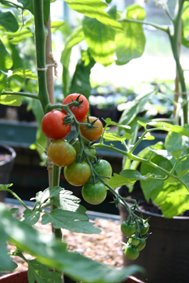
A bumper crop of tomatoes were grown, again relishing the long summer, and the sweet gardeners delight were delicious.


Another easy crop we grew were the chilli peppers. They not only look fantastic, but add a real kick to the ratatouille!