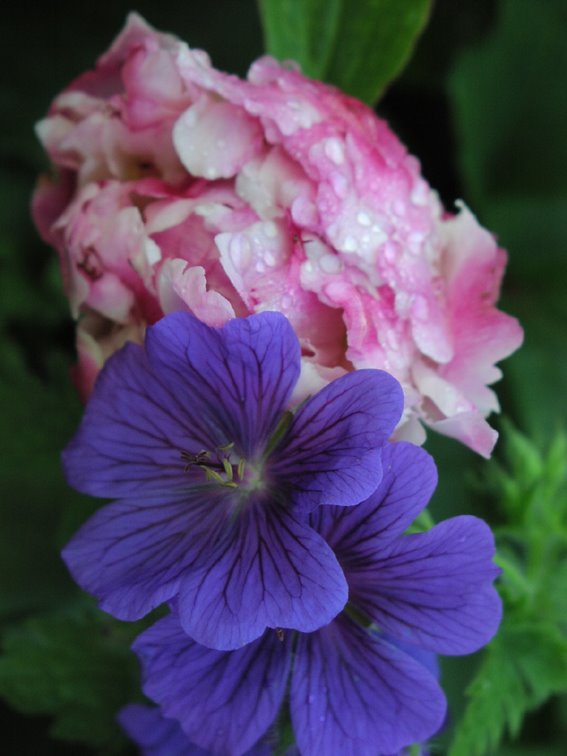
Geranium magnificum and Paeony


You can't get a more sumptious combination than this!

Iris Sibirica 'White Swirl'


A wonderful clear white, with a hint of yellow at the base. This iris prefers
damp soil and some shade.

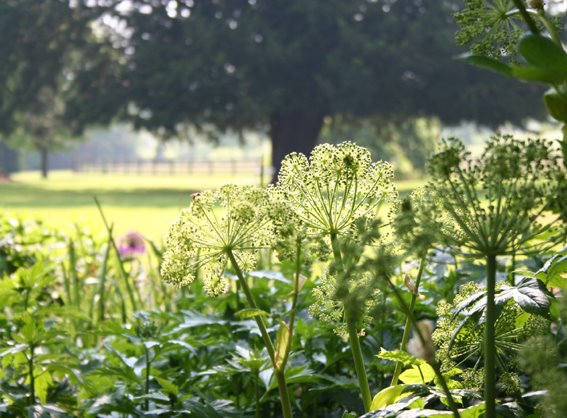
Angelica archangelica


Angelica archangelica flowerheads add a lovely structural element to the herbaceous borders

Garden Open Day

Our Annual Garden Open Day was a great success, with over 600 visitors to the garden. The weather was how you would describe as 'changeable' with a few short, sharp showers for good measure, but spells of welcome sunshine too. Still too nippy for the end of May though!

As we have had awful weather for the last two weeks - very cold and wet, the flowers that are usually looking great were still tight in bud, but the hostas, alliums and bluebells were looking perfect (if I dont say so myself!)

As all 5 gardeners were helping on the advice desk and selling plants we had propagated ourselves, we were able to sneak out for a visit to the other gardens in Toddington that were open on the same day. The ones we managed to visit really were quite varied and different, and in each one, there were ideas that could inspire other gardeners, be it how to deal with a difficult shady spot, awkward levels, tiny spaces or recycling in the garden - gardeners are the most inventive people out there, I am sure.

Fascinating Tales from the past

On the open day we had the pleasure of meeting two very interesting people. First was a gentleman, who introduced himself as the grandson of a previous Head Gardener, Horatio Plumb who worked at Toddington Manor for Colonial Skinner in 1914. Unfortunately he did not have any photos of Horatio at the manor (that would have been wonderful to see) but is was very interesting to talk with somebody who has direct links with the history of the manor. It would have been SO interesting to talk to Horatio him self - I bet a few things have changed since he was Head Gardener! (I wonder what he would of thought of a female in charge?!)

Then a lovely lady introduced herself as a evacuee in the Second world War, who arrived with her mother and 5 brothers and sisters to spend the duration of the war in the safety of the country, while bombs were being dropped on London. Again, a lot of changes have happened, but the memories were fascinating to hear.

It is great for people to make the effort to revisit the Manor that have a place in their family history, and to hear their stories.

May in the Garden


Well, what a month! Apologies for not posting much this month, but we seem to have not stopped work at all. The saying 'March winds and April showers bring forth May flowers' has not applied to 2006.

More like 'May wind and May showers bring forth May flowers'!

Still, we can cope with whatever the weather can throw at us, we are hardy gardeners... The last week has been spent mowing, tiding, sweeping, weeding, rushing, and changing wet gloves for a fresh pair each break, as we get ready for our open day on the 29th, Monday Bank Holiday.

The plants are revelling in the lush conditions, and when the sun does come out, I am sure you can hear the leaves growing. As you can see in the picture, the alliums and bluebells along the length of the Herbaceous Borders look stunning at the moment, the ferns and hostas are unfurling and euphorbia charachias subsp. wulfenii with its acid green flowers adds a lovely, sharp edge to the colour scheme.

Put it in your diary, only 4 days left to go - and the weatherman promises no rain!
Hosepipe ban - watering plants

In this part of Bedfordshire, we have escaped the hosepipe ban so far, but it is still early in the year.

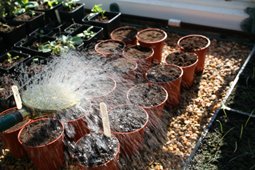
But we are lucky that the Victorians were so resourceful, as our lovely old greenhouse and vinery has a large reservoir built underneath to catch all the rainwater from the glass roofs, and safely stored until we need it. It is much better for the plants, rather than using the local hard water and as it is pumped up to a smaller tank in the greenhouse, the ambient temperature is raised too, so it is far less of a shock to delicate seedlings when they are watered using a fine spry with the watering can.

Speaking of which...we use Haws metal watering cans, they are such a good, long lasting design, and the only part we have replaced in the last 13 years is the rose, which tends to split along the welds - but not bad for the use it gets.

Helleborus orientalis still looking fabulous

Our 100 metre long herbaceous borders have drifts of hellebores positioned just behind the hostas flanking both sides of our old stone path. Before these unfurl during spring the hellebores are the highlight of the borders.

They have been flowering for about a month already, but as the 'petals' are not really botanically correct, rather they are sepals - which are far more weather resistant (you can just see in the photo the true petals peeking out from the dark centre around the stamens).

We have a creamy white variety for most of the borders, but in the middle beds a riotous mix of cream, pink, purple and nearly black, all with various spots and streaks.

The white ones do have a certain air of dignity about them - but you really can't beat the mixed colours against a clear blue spring sky.

Sowing seeds and more seeds...

The greenhouse is a frenzy of pots, seedlings, trays and watering cans. This time of year, however big your greenhouse, it always ends up shuffling pots around as they grow and fill their allocated space, seedling get pricked out and use up 10 times their area, and young plants need transferring to our frost free vinery to start hardening off before planting out.

The last few seeds are going in the propagator now, large seeds of the Melons and Cucumbers for training up the metal framework in the vinery - compare these to the tiny grey-white seeds of brachysome, hardly visible when sown. It is always interesting when growing from seed opening the packet of something you have not tried before. The shape, colour and size of different seeds are so varied!

Just remember the rule of thumb for beginners sowing seeds - cover the seed with about the same depth of compost, this way the food reserves can power the seedling to the surface. Too deep and it will run ot of energy before it reaches the surface. The tiniest seeds do not even need covering, just ensure they are kept moist. And there will always be exceptions to this rule as some seeds require light to germinate so if you can always check before you cover them up!

Spring mulch on the borders

We are now well underway with the spring job of mulching our borders. The green waste does an excellent job of covering up those tiny weed seedlings that are just germinating as the April sunshine and showers are providing perfect conditions for them. As they are annuals, they just do not have the root system to cope with an inch of mulch on top of them, so they will die.

Whereas the perennials tolerate the mulch well, as long as you avoid throwing it right on top of their crowns, they look lovely too, the dark colour showing up the fresh green leaves at this time of year.

The job is made a little easier by using our 3-wheeler to transport the mulch as close as we can get it to the borders, and from there it is all shovelled on by hand - this usually brings on the first afternoons wearing t-shirts as its as energetic as it sounds!

Green Waste Mulch

Hey, can you guess what the gardeners will be doing over the next 6 weeks? The clue is in the photo!

We had our delivery of mulch last week, for all the beds in the garden. It is 50 cubic metres of Green Waste, garden clippings collected and recycled from your green wheely bins and local councils garden waste in the dumps, all composted and reused as a mulch and soil improver.

We have been using this for the last 6 years or so, and have never had any problems with weeds, disease or pests appearing. It is wonderful for mulching and we spread a generous layer on all our beds, which look wonderfully neat after this, a rich dark colour.

I shall post a photo of work in progress soon - and yes, it is all shovelled on by hand...

Climbing roses neatly pruned


Our climbing roses in Georges Bed are all neatly pruned around the wooden posts they wind their way around.

By training as close to the horizontal as far as practical, the hormone that promotes growth, Auxin, is more evenly distributed along the stems, rather than rushing straight to the tips as in a vertical stem, therefore encouraging more flowers lower down on the plant.

This year we are planting Clematis viticella cultivars 'Kermisina', 'Niobe', Polish Spirit' and 'Blue Belle' to clamber up the poles alongside the roses, to add extra colour during Summer.

Hardy ferns get the chop!

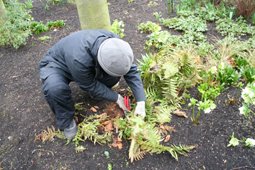
After a close inspection, our hardy ferns look just about perfect for their annual cutting down. Just look inside all the old leaves, and see if the new little fronds are looking like they are ready to burst into growth.

If you cut off all the old leaves before they start to unfurl it is a much quicker job than when they have started as you must be careful not to damage any of the new growth. We leave all the old leaves on until this stage, as it gives them a little protection against the harsh winter frosts.
Its also a good chance to clear any old leaves, debris and snails that have made their home in the the lovely dry base of the plant before spring arrives.

Onion sets or onion seeds?

Which will be better onions - those grown from seed or from sets?

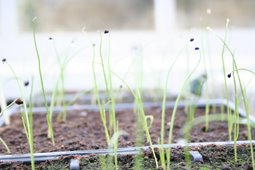
To settle this dilema, this year we shall be growing one onion from seed (Red Baron) - and one from sets (Snowball). The sets arrived in Feburary and were planted in multi-purpose compost in pots on the 8th, the seeds were sown in March in the heated greenhouse.

So place your bets now....

Dividing dahlia tubers

For the first time last year in our potager, we grew a lovely, dramatic dahlia called 'Chat Noir'.


It is a variety recommended in Sarah Ravens catalogue, grown for its dark red, almost black velvety petals, and a contrasting lime green centre - a truly wonderful cut flower which continued producing flowers right up until our first frost in November.

The perfect job for a wet and windy afternoon in March, I showed Barbara and Debbie how easy it is to divide dahlia tubers for more plants this year. The plants had grown well this last year, and we managed to obtain about 6 tubers divided from the main plant, so by the end of the afternoon 18 new plants were potted up into multi-purpose compost and placed in the vinery to allow them into growth earlier and to keep an eye on them, the three original plants were left a decent size, and replanted into the potager in a different place according to the 2006 design.

A little taster as to what to expect when the flowers burst open again is below...

Mowing grass for the first time

Last week, the weather was perfect to start getting the lawns ready for spring (when it does finally arrive). Although the grass is not growing just yet, it does grow a little over winter, so to neaten it up we cut it very lightly.

Using our John Deere 755, which has a grass collection system, we can effectively hoover up any debris such as leaves and cones from the lawns.

As it has been so windy, the grass was lovely and dry, so out I ventured, wrapped up in several layers to keep warm, and mowed all our lawns. The previous day I had used a pedestrian rotary mower for the same reason on all our smaller lawns.

Its always lovely to smell the grass cutting for the first time of the year. Even with 5 layers and a woolly hat on!

Osteospermum 'Glistening White'


Seed sowing is continuing throughout March, as space becomes available in the heated propagator. This heat is required for germination in some seeds, but the greenhouse is heated so for many seeds, this is warm enough.

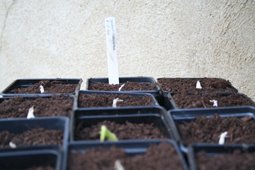
Pictured is Osteospermum 'Glistening White' one seed per module, this was then covered with a very light dusting of compost. Thoroughly watered, the clear propagator top went on, then left on the greenhouse staging to its own devices. Around 10 day later we have over 100 healthy seedlings germinated, no need for the propagator top now, or you risk etiolated seedlings - long, leggy plants reaching up to the light.

PS We have now renamed this variety to 'Gusting White', after Rachael misread the label. A far more interesting name, we thought.

Chimonanthus praecox, or wintersweet

Nestled on the brick wall in the rose garden is a wintersweet, also known as Chimonanthus praecox.


It is in a sheltered spot, and grown as a wall shrub for that little bit of extra warmth throught he coldest months. Once the sun has risen and warm the bloows, a delicious scent is carried on the air, a well chosen common name is wintersweet.

Looking closer, the petals are almost translucent, so delicate they really don't look like they will withstand any frost, but they keep on flowering. This is the first year we have had a really good show on this plant, as they take a while to settle in, but after about 5 years, looks like there is no stopping it now!

Sharon Pearson, Garden Photographer


We had a visit by Sharon Pearson, a talented garden photographer who spent the afternoon with us snapping away. So I couldn't resist taking her photo, of course.

We were very lucky to have one of those bright, crisp winter days, so hopefully the photos Sharon took will be fantastic!

Watch this space!

To see other photos visit her website at www.sharonpearson.co.uk

Coldest winter for a while...

Well, it is now official. The Met. Office has announced it has been the coldest winter since 1996/97. After the last two weeks I can certainly believe it!

Barbaras gloves were left out overnight by mistake, and by the following morning were encrusted with shimmering frost - along with everything else.
We have been waiting for the weather to allow us to prune our pleached lime walk, but hopefully this coming week will be milder, albeit forecast wet for the next week now.

But what else would gardeners moan about, if it weren't for the weather!