Showing posts with label Ramblings From The Potting Shed. Show all posts

Plants Life Cycles

Someone recently asked me what a perennial actually was, and I thought it would be useful to recap on a few common botanical words which most gardeners are familiar with, but may not realise what they really mean. All plants have different life cycles ranging from very brief to thousands of years…


Annuals complete their life cycle in one year, they grow from a seed, flowers and set seed, after which they die. Chickweed and Sweet Peas are both examples. Also commonly known as annuals are Ephemerals – these can complete many life cycles in one year, such as the pernicious weed Bittercress. Many bedding plants are treated as annuals but in fact frost-tender perennials, such as petunias


Biennials complete their lives over two years, growing from seed at the end of the first year, continue to grow and then flower early the next year, set seed in the summer then die, such as Sweet Williams.


Perennials live for more than two years and in most cases, many years. Trees, roses and shrubs fall under this category, these have a permanent structure, herbaceous perennials grow and bloom over the spring and summer and then die back every winter, their root-stock (or crowns) surviving below ground to re-shoot again in the spring. All perennials are either deciduous, dropping their leaves every Autumn, or evergreen, retaining their foliage all year.

What soil do I have?

Every garden soil is different. All are mixtures of sand, clay and silt, but in differing quantities.

To determine what your soil is, take a piece of soil about the size of a golf ball and roll between your fingers removing any large stones. Now try to roll into a ‘worm’ shape.

A sandy soil will not form this shape, it simply falls apart. If you can form this shape easily and when rubbed, the surface turns shiny, this is clay soil.


However, if the ‘worm’ can be crushed in the palm of your hand, then you have a loam soil, perhaps the most desirable of soil types. Very similar is a silty soil, which possesses a silky feel.
You can improve every soil by adding organic material such as compost or manure. This helps bind particles together in a sandy soil, or helps clay soil become more workable.

Knowing your soil will help you choose the right plants for your garden and enjoy more success growing healthy and happy plants.

Planting for sandy soil

Anyone who possesses heavy sticky clay soil will always pine for a light, sandy soil, yet this is not the best soil. Although much easier to cultivate, the main problems with a light sandy soil is compaction and the inability to retain water and nutrients.
As the sand particles are small, rain will wash through these particles and cause them to ‘pan’ or form a hard surface crust, making it difficult for young plants to establish. This type of soil is free draining, so although it can be easier to dig in autumn or spring, saving your back, it will dry out quickly in summer so plants need to withstand periods of drought. It is this rapid loss of water that leaches out nutrients also, so to sum up, plants will be hungry, thirsty and slow to establish!

The key step to improving sandy soil is the addition of organic matter in large quantities, year after year. Manure, compost, green waste, leaf mould, or mushroom compost – all contain something called humus – a black fibrous material formed from organic matter of decomposed plant or animal residues. This will coat individual soil particles, helping retain water, nutrients and give structure to the soil.

Some planting ideas to get you started are...

Grasses
Helictotrichon sempervirens

Trees
Amelanchier lamarkii
Cercis siliquastrum
Robinia pseudoacacia ‘Frisia’

Climbers
Jasminium officinale

Perennials
Agapanthus ‘Bressingham White’
Echinops ritro ‘Veitch’s Blue’
Kniphofia ‘Little Maid’

Shrubs
Artemisia ‘Powys castle’
Caryopteris x clandonensis ‘Heavenly Blue’
Philadelphus coronarius

A Touch of Frost

Just as we prepare for winter, changing our habits and clothing, plants are quietly going through changes too. The most striking of these is leaves turning to lovely autumnal colours. This occurs as the chlorophyll degrades in the leaf, so we can see the other pigments that are there all year too, but masked by the green chlorophyll. These include orange carotenoids, purple-red anthocyanin, and yellow xanthophylls. Hormones then cause the leaves then abcise, (from the Latin ‘to cut off’), thereby protecting them from winter frost damage.

Evergreen plants protect their leaves from freezing by using their own ‘antifreeze’. This is just a high percentage of dissolved sugar and amino acids in the cells, which lowers the freezing point of water.
This is the reason why late spring frosts can be so devastating to fresh blossom and new leaves, as these changes have not occurred. Once the fluid contained within the cell has frozen, it expands and breaks the cell wall beyond repair.

The shortening days also induces dormancy in many plants, an example being the transformation of buds to withstand the cold days ahead with thick protective scales (as can clearly be seen on Horse Chestnuts).

When is a bulb not a bulb?

Looking at all the tiny specks of green starting to push out of the ground, one of the first signs spring is definately on the way again, but when is a bulb not a bulb? Ohh the conversations gardeners have!?

You may think that if a plant has an underground storage organ, that remains there year after year, pushing through the soil to flower such as lilies, crocus, cyclamen, erythronium, iris, daffodils lily of the valley and dahlias, then it must be a bulb.


But you would be wrong! Although some of these are true bulbs, the internal structures are quite different – if you look at where the buds and roots originate, and cut them in half you can see how they are all really either adapted stems or roots. We looked them up in a book to make sure - its a long time since I was at college...

· Bulbs – Modified stems, where the overlapping leaves have been adapted to swell and store food and nutrients for the plant eg. Lilies & Daffodils
· Corms –Stubby modified stems, which are vertically orientated eg. Crocus & Erythonium


· Tubers - Short, thickened regions of stem or root, which are used to store food for later growth eg. Cyclamen (stem) & Dahlia (root)
· Rhizomes - Modified plant stems that grow near the soil surface and producing the upward shoot and downward root system eg. iris and lily of the valley.

Plants often modify themselves to ensure survival, and all these modifications occur to survive the British climate - when temperatures drop below freezing, the plant does not have to produce food using photosynthesis – it has plenty stored already for the next year.

A Wedding at the Manor

One of the big events of last year was my wedding to Pat, after no less than 17 years of living together - we thought it was about time!

We had a lovely informal ceremony in May at the neighbouring Flitwick Manor, and all guests then travelled to Toddington Manor gardens to have the obligatory glass of champagne and accompanying photos.

All the gardeners had been busy making it look spick and span the previous week, and the alliums which line the herbaceous borders looked at their best. I was lucky enough to be able to create my bouquet from the flowers and foliage in the gardens (my previous job ages ago was in a florists, so the experience came in handy!) and the flowers for the tables also were from the gardens.
It was a small wedding party, so then back to Flitwick Manor for the feast and speeches, and the day was rounded off by a barbeque in the back garden. We had watched the weather all week, crossing fingers and toes, and as luck would have it, we managed to get married on one of the few sunny days last summer, and it even had the decency for one small rain shower just as we were eating, so didn't disrupt the day at all.


The Manors owners we even on hand to help serve the champagne to our guests from the conservatory, and I managed to pose for one photo with a fork, and one on the 3 wheeler garden truck too! We both had a great day, and it was made special by spending time in the gardens with everyone, along with the individual bouquet and finished with friends, family and all the staff enjoying the evening at home.

New Years resolution!

I'm Back!! My New years resolution is to keep up with the blog posts this year!
I hinted that last year was very busy through one thing and another, so I shall be posting whats currently going on throughout the year, and filling you in on last years developments too.

I hope this damp and horrible weather that seems to stick around for ages will dissappear soon, and we can all look forward to springtime. The birds have started singing in earnest already, looking for mates, which is always nice to hear this side of christmas. The first signs of growth are appearing too, it always seems too early each year, but look closely and buds are swelling in readiness.

We have had a few changes in staff recently, I shall fill you in with the details in another post, but Julie, the new gardener has started working part-time and three weeks into the job is getting stuck in, clearing the borders.


Damp January Borders

This January has been damp again, like the last few months, and not the best condition to garden in day in day out, but work must carry on as otherwise spring will be upon us and the beds and borders will not be cleared, shrubs and roses pruned, and sheds tidied.


The herbaceous borders are now cleared, and forked over, in readiness for their mulch which we shall put on during march. This is a process which we carry out on all the beds during winter.
First, all the old and dying foliage is removed to the ground, using secateurs or shears depending on the type of plant. This gets put into our petrol driven 3-wheeler truck (which was incidentally a birthday present to Lady Bowman-Shaw many years ago from her husband - and is still going strong!) to be taken away - much more efficient than barrows given the amount of material we remove.

Then we carefully rake over the soil to remove leaves which have collected during autumn, paying careful attention to the base of shrubs and grasses so no hiding places for bugs, slugs and disease remain.

Lastly, the whole bed is 'forked over' which is carried out using the smaller ladies fork or border fork, and lightly aerate the top 3-4 inches of soil - this incorporates the remaining mulch from last year, and exposes any pests and/or their eggs.

I like to make sure that any dips and bumps are removed from the beds at the same time by gently sweeping the fork from side to side after forking over, this gives that professional finish and also breaks down any large clods of earth left - then we stand and admire for a little while - before the bunnies, pheasants and leaves blowing about in the wind start to mess it up again! We will tidy them up quickly before the mulch gets put on though, so nothing is buried underneath.

Updates for The Garden - 2007


You may have noticed that my updates for the garden in 2007 have been a bit thin on the ground!


Apologies for this, but this year has been very busy for various reasons, such as a range of new garden courses, getting married, a very dry spring then a very wet and dismal summer, flooding in the garden, many weeds and the lawns continuously growing, as the garden has 'enjoyed' damp and warm conditions most of the year.


I will update you with what has been happening with new posts, looking back at the year to date.

Snow in January's garden

This month we had our first snowfall in Toddington. It had been exceptionally mild and wet before this, but unexpectedly one morning, we woke up to a crisp white blanket covering everything. Gardens always look so neat and clean under the snow, and there is little gardeners can do outside, but it is always worth checking no branches have snapped under the weight of the snow, and theres always the job of keeping the driveway and paths snow free!


This photo show the woods behind the Manor, the main lawn in front of the house and the wonderful mature trees like the walnuts, ceder of lebanon, wellingtonias, silver lime and copper beech. The cricket square is at the bottom of the photo, as the grass is kept shorter here, it stands out against the longer outfield grass.


There a few plants braving the cold conditions of winter - the hardy ferns including dryopteris wallichiana, helleborus orientalis is almost blooming, and the marbled leaves of arum marmoratum are looking lovely.
The structures in the garden such as the wooden obelisks in the main herbaceous borders stand out against the snow too.

Our pleached are waiting patiently to be pruned back their knobbly knuckles, but look glorious against the pink manor and white snow. They are the red stemmed cultivar - tilia platyphyllos 'Rubra', so we like to leave the stems on as long as possible so providing interest during the long winter months.

Fog.... and more Fog


A few weeks ago (in December) the whole garden and estate was shrouded in fog for days. Flights started to back up at the airports, and the whole world had gone quiet. High pressure does a wonderful job of creating a sense of stillness and quiet in the garden. I love this atmosphere, even though its so cold going down the drive on the bicycle!


Then the sun starts to seep through the murk and walking around the garden looks completely different - I guess you are only focusing on the ground as these is a white blanket above, so details seem to jump out at you much more. There is little you can do outside on days like these where the frost doesnt lift, so its a good chance for us to tidy the greenhouses and vinery.


November colour in the Garden

We are getting later and later frosts these past few years, so the first frost now seem to occur in November, rather than October. This helps prolong the colour in the borders, although as the winters are now effectively shorter, this leaves us with less time to thoroughly clear the borders - yes, it really does take about 4 months to tidy, clear away dying foliage, weeds, move stray plants and fork over the all the beds at Toddington Manor.

When we have the first frost it always seems to catch me by surprise - the summer evenings seem so recent and the borders still look good. I always keep a close eye on the water forecast so all the large summer pots placed around the garden with tender margurite Daisy's are all safely tucked away in the frost free vinery.
The dahlias and cleomes still look great while the frost is still on them, but tomorrow morning all the cells will have been ruptured and turn the whole bloom to a dirty sodden brown lump - not so attractive!
Our rich red rhubarb chard will not suffer so badly - the outer leaves may be for the bin, but the inner leaves will still be able to be harvested. In fact, this is one ornamental vegetable I would not be without in the ornamental potager. It seems to tolerate heavy rain, drought, pests leave it alone, it is easy to germinate, looks gorgeous whilst patiently sitting there waiting for a gardener to harvest the rich red, crinkly leaves.
It is even listed as a super food along with the equally spectacular kale. They both have an 'acquired' taste, which basically means they are both quite bitter compared to the ordinary vegetables you can buy at the supermarkets, but combined with other vegetables, especially in soups, they are really quite good.

Autumn leaves

Have been very busy of late with another project, but have found a little time over the holidays to update you all on whats been happening over the past couple of months at the Manor.

We have had a very windy Autumn in Toddington this year. Not so good for gardeners as working on days when the wind incessantly blows can really wear you down somehow - the gardeners have been talking about this and the end result was that if you wear ear defenders whilst weeding, it doesn't affect you at all, so it must be the noise that makes your head 'busy'!
Feeling pretty daft while wearing them though!!!


Its lovely when the wind blows when the leaves are falling though, as we use petrol powered leaf blowers to move the leaves of our lawns, (which means wearing the aforementioned ear defenders.) Otherwise the worms end up dragging them down under the soil, and really makes the lawns quite messy. Also, the leaves collect in sheltered corners and if left to sit there for more than about a week the grass underneath will yellow and even die eventually.

Toddington Manor is very lucky to have some wonderful trees on the main lawn, and some of these colour well in the autumn, such as...


Red Horse Chestnut (aesculus x carnea)


Persian Ironwood (Parrotia persica)


Golden Robinia (Robinia pseudoacacia 'Frisia')


Croquet lawn 'Umpires Bank'

At the back of our quintessential English Croquet Lawn, we have a border we call Umpires bank. Whether or not the game of croquet has an umpire, I am not sure, but it is called this because originally there was a rather awful hard surface tennis court surrounded by an equally attractive chain link fence. When the owners children were young, this was a great addition to the garden, but as they all grew up and moved away, it was not really getting much use. So Robin, the previous head gardener replaced this with a croquet lawn, which transformed this area.


As the fence was removed, umpires bank became more visible, so we have improved the planting here. As it is viewed from a distance, bright colours add impact, such as the wonderfully statuesque Inula magnifica, and brick red day lilies. Orange-yellow Helenium 'Waldtraut', evergreen punctuation marks of Hypericum 'Hidcote' , feathery plumes of bronze fennel and two Laburnums stand sentry each side of the umpires bench!

The croquet lawn has suffered this year because of the drought, and although we have not got a hosepipe ban in our area yet, the searing heat has meant the lush green sward of last year is a memory at the moment. But grass has the wonderful ability to start growing again as soon as the weather becomes kinder to plants again.

Inulas are lovely architectural plants for the back of this border, with their large leaves and yellow daisy flowers and the bees are clambering over one another to get to the pollen this week

May in the Garden


Well, what a month! Apologies for not posting much this month, but we seem to have not stopped work at all. The saying 'March winds and April showers bring forth May flowers' has not applied to 2006.

More like 'May wind and May showers bring forth May flowers'!

Still, we can cope with whatever the weather can throw at us, we are hardy gardeners... The last week has been spent mowing, tiding, sweeping, weeding, rushing, and changing wet gloves for a fresh pair each break, as we get ready for our open day on the 29th, Monday Bank Holiday.

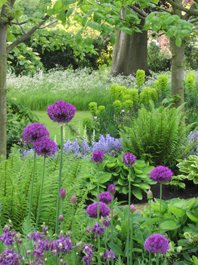
The plants are revelling in the lush conditions, and when the sun does come out, I am sure you can hear the leaves growing. As you can see in the picture, the alliums and bluebells along the length of the Herbaceous Borders look stunning at the moment, the ferns and hostas are unfurling and euphorbia charachias subsp. wulfenii with its acid green flowers adds a lovely, sharp edge to the colour scheme.

Put it in your diary, only 4 days left to go - and the weatherman promises no rain!

Hosepipe ban - watering plants

In this part of Bedfordshire, we have escaped the hosepipe ban so far, but it is still early in the year.
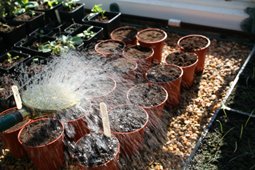
But we are lucky that the Victorians were so resourceful, as our lovely old greenhouse and vinery has a large reservoir built underneath to catch all the rainwater from the glass roofs, and safely stored until we need it. It is much better for the plants, rather than using the local hard water and as it is pumped up to a smaller tank in the greenhouse, the ambient temperature is raised too, so it is far less of a shock to delicate seedlings when they are watered using a fine spry with the watering can.

Speaking of which...we use Haws metal watering cans, they are such a good, long lasting design, and the only part we have replaced in the last 13 years is the rose, which tends to split along the welds - but not bad for the use it gets.

Spring mulch on the borders

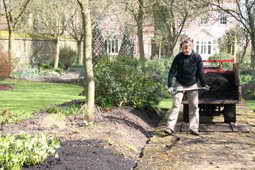
We are now well underway with the spring job of mulching our borders. The green waste does an excellent job of covering up those tiny weed seedlings that are just germinating as the April sunshine and showers are providing perfect conditions for them. As they are annuals, they just do not have the root system to cope with an inch of mulch on top of them, so they will die.

Whereas the perennials tolerate the mulch well, as long as you avoid throwing it right on top of their crowns, they look lovely too, the dark colour showing up the fresh green leaves at this time of year.

The job is made a little easier by using our 3-wheeler to transport the mulch as close as we can get it to the borders, and from there it is all shovelled on by hand - this usually brings on the first afternoons wearing t-shirts as its as energetic as it sounds!

Green Waste Mulch

Hey, can you guess what the gardeners will be doing over the next 6 weeks? The clue is in the photo!

We had our delivery of mulch last week, for all the beds in the garden. It is 50 cubic metres of Green Waste, garden clippings collected and recycled from your green wheely bins and local councils garden waste in the dumps, all composted and reused as a mulch and soil improver.

We have been using this for the last 6 years or so, and have never had any problems with weeds, disease or pests appearing. It is wonderful for mulching and we spread a generous layer on all our beds, which look wonderfully neat after this, a rich dark colour.

I shall post a photo of work in progress soon - and yes, it is all shovelled on by hand...

Climbing roses neatly pruned


Our climbing roses in Georges Bed are all neatly pruned around the wooden posts they wind their way around.

By training as close to the horizontal as far as practical, the hormone that promotes growth, Auxin, is more evenly distributed along the stems, rather than rushing straight to the tips as in a vertical stem, therefore encouraging more flowers lower down on the plant.

This year we are planting Clematis viticella cultivars 'Kermisina', 'Niobe', Polish Spirit' and 'Blue Belle' to clamber up the poles alongside the roses, to add extra colour during Summer.

Hardy ferns get the chop!

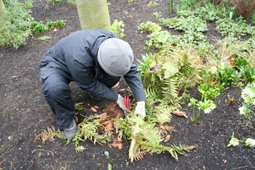
After a close inspection, our hardy ferns look just about perfect for their annual cutting down. Just look inside all the old leaves, and see if the new little fronds are looking like they are ready to burst into growth.

If you cut off all the old leaves before they start to unfurl it is a much quicker job than when they have started as you must be careful not to damage any of the new growth. We leave all the old leaves on until this stage, as it gives them a little protection against the harsh winter frosts.

Its also a good chance to clear any old leaves, debris and snails that have made their home in the the lovely dry base of the plant before spring arrives.